

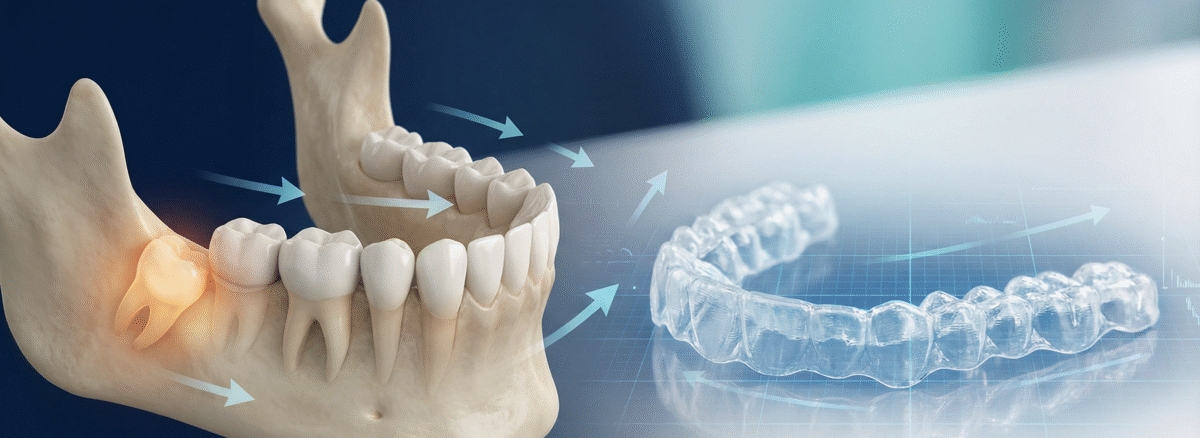
Wisdom teeth (Third Molars) remain one of the most debated topics in modern orthodontics. With the rise of the digital dentistry era and Clear Aligner Therapy (CAT), the clinical decision has shifted from “routine prophylactic extraction” to “strategic functional extraction.” In this guide, we explore the scientific evidence that dictates the necessity of extraction before starting your journey with AlignWB.
The Reality: Wisdom Teeth and Anterior Crowding
For decades, it was a common clinical assumption that erupting wisdom teeth “pushed” the entire arch, causing lower incisor crowding. However, contemporary orthodontic literature confirms that Late Physiologic Crowding is a natural phenomenon related to aging and late mandibular growth—not wisdom teeth.
True causes of late crowding include:
Age-related physiological changes in the dental arch.
Late mandibular growth patterns.
Non-compliance with Retainers following orthodontic treatment.
When Is Extraction a “Biomechanical Necessity” in Clear Aligner Therapy?
In the AlignWB protocol, the decision to extract is never arbitrary. It is based on the biomechanics required to move your teeth effectively:
1. Creating Space for Molar Distalization
In cases of moderate-to-severe crowding, clear aligners are highly efficient at moving posterior teeth backward (distalization) to create space for the front teeth. In such scenarios, a wisdom tooth acts as a “mechanical blockade,” preventing this movement. Its extraction becomes the “key” to unlocking the digital treatment plan.
2. Impacted Wisdom Teeth
If a wisdom tooth is impacted (trapped under the bone or gum) at an angle that threatens the stability of the second molar or causes root resorption of adjacent teeth, its removal becomes a clinical priority to protect your long-term results.
3. Tray Seating and Anchorage
In some cases, a partially erupted wisdom tooth can prevent the clear aligner from fully “seating” or wrapping around the last molars. This weakens the orthodontic anchorage, reducing the precision of the programmed tooth movements.
How AlignWB Technology Resolves the Debate Digitally
What sets your AlignWB journey apart is that we replace clinical guesswork with data-driven precision:
- 3D Simulation (VTO – Visual Treatment Objective): We use advanced software to simulate the movement path of every tooth. If the simulation detects a “collision” between the planned tooth path and the wisdom tooth’s location, extraction is recommended as a proactive step.
- Expert Clinical Assessment: When you Request Aligner, a licensed orthodontist or certified dentist analyzes your panoramic X-rays integrated with digital scans to ensure wisdom teeth won’t interfere with future progress.
Professional Tips Before You Begin
Radiographic Imaging: Never start orthodontic treatment without a Panoramic X-Ray to evaluate root morphology and anatomical relationships with the alveolar nerve.
Compliance is Key: The success of our digital planning depends on wearing your aligners for 20-22 hours per day.
Conclusion: Wisdom teeth extraction is not a routine requirement for every patient. It is a strategic engineering decision aimed at facilitating tooth movement via the most efficient path. With AlignWB’s digital planning, we ensure a precise treatment path that avoids unnecessary surgeries.